Start from the gap
A retrofit starts with three facts: the limit, where it applies, and how far the installed set is from it. Measured levels, usually from the acceptance test or a site survey by the owner or a test provider, show the size of the gap and, with spectra, which frequencies carry it.
Then the sources and paths are ranked. On an enclosed generator set the exhaust outlet and the enclosure’s cooling-air inlet and outlet are often the dominant paths, but which one dominates on a particular site has to be established, not assumed.
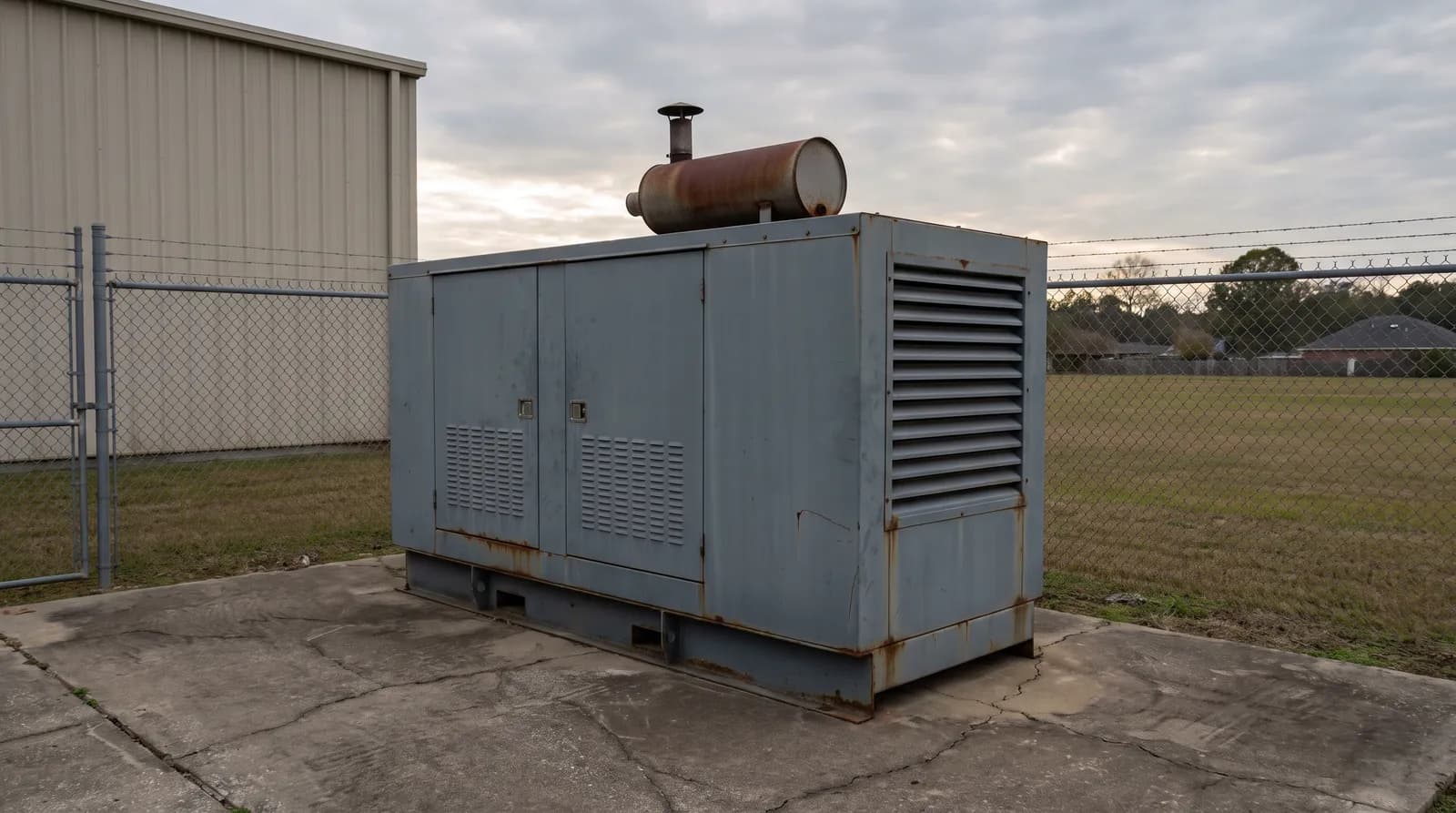
Why installed sets miss their targets
- The dominant path wasn’t the one that was treated. On an enclosed set, the exhaust outlet and the cooling-air inlet and outlet are often the dominant noise paths, and which one leads depends on the installation.
- Low-frequency tones. Exhaust noise is usually strongest at the engine’s firing frequency and its harmonics, which on many generator sets are low in frequency, where absorptive lining alone gives little attenuation.
- Silencer performance quoted as transmission loss, which describes the silencer on its own, while what the site hears depends on insertion loss, which also depends on the engine and on the piping and outlet around the silencer.
- Source data that differs from what the design assumed: a different engine rating, fan or operating condition.
- Openings, gaps and penetrations in the enclosure that let sound out around the treatment.
Retrofit options, compared before anything is changed
| Change | What it addresses | Checked against |
|---|---|---|
| Exhaust silencer upgrade, or an added silencer element | Exhaust outlet noise, including low-frequency firing tones | The engine manufacturer’s back-pressure limit |
| Longer or more closely spaced splitter silencers, or attenuators on a generator room’s openings | Fan and engine noise escaping through the cooling-air openings | The allowable cooling-air restriction and the radiator’s airflow |
| Acoustic louvers or a different discharge arrangement | Noise leaving through the cooling-air openings | The allowable cooling-air restriction |
| Changes along the exhaust route: piping, bends, rain cap, outlet | Back-pressure headroom that makes a quieter silencer possible | The total back pressure |
Each option is compared on two measures: the predicted change in level against the gap, with its uncertainty, and what it costs in back pressure or cooling-air restriction. Where a change raises the air or gas velocity, the flow-generated noise it may add is estimated from the CFD velocities with empirical correlations. Quieter cannot mean hotter, and a quieter silencer is no fix if it breaks the engine’s back-pressure limit. Enclosure and generator room airflow · Exhaust back pressure explained
What to send, and what comes back
What you send
- The site sound limit and where it applies
- Measured levels and measurement positions from the acceptance test or a site survey, with spectra where available
- As-installed drawings or photos of the enclosure or generator room, silencers, louvers, attenuators and exhaust route
- Engine data: speed, number of cylinders, and exhaust flow and temperature at the rated load
- The engine manufacturer’s back-pressure limit and the generator-set manufacturer’s cooling-air data
What comes back
- A ranking of the noise sources and paths
- Retrofit concepts with their predicted effect, its uncertainty and the trade-offs
- Back-pressure and cooling-air checks for each concept
- Recommended changes and a verification approach for the owner’s or test provider’s measurements
Please don’t send CAD through the website form. Files are exchanged after first contact.
Where this applies
- Generator Sets & Power GenerationStandby and prime-power sets in outdoor enclosures and indoor generator rooms on industrial and commercial sites, including sites with a limit at a distance or property line.
- Generator and engine noise reductionThe same models applied at the design stage, before a set is installed.
Related services
- Noise Control & MitigationRanking sources and paths and comparing fixes before hardware changes.
- Acoustic Modeling & SimulationPredicting what a silencer, louver or ventilation-path change does to the level.
- CFD Flow & Pressure DropChecking a quieter silencer against the engine’s back-pressure limit.
Sources
- Federal Highway Administration, Noise Barrier Design Handbook, 3. Acoustical Considerations (adding decibels by converting to energy)